Getting Ready for PostgreSQL 19
PostgreSQL 19 Beta 3 shipped on August 13, 2026, and the release notes have been filled in as of 2026-07-18 — still marked subject to change, and the GA date isn’t announced yet, but following the project’s usual September/October cadence general availability should land within the next few weeks. That makes now the right time to read through what’s changing, the same way I did for PostgreSQL 11 through 18 a few weeks ago.
This is not a changelog dump. It’s the subset of PG 19 I think is worth knowing about before you upgrade: a handful of compatibility breaks that will bite people who don’t read release notes, and the SQL-level additions I found genuinely useful once I started poking at them. Every query below ran against a real PostgreSQL 19 Beta 3 instance — no hand-waving about syntax that might work.
Update, 21 September 2026. Five features below have been withdrawn from
PostgreSQL 19 since this went out: MERGE PARTITIONS and SQL/PGQ (already
marked in their own sections), FOR PORTION OF on 15 September, the
pg_get_*_ddl() functions on 12 September, and — from the watch list at the
end — online data checksums on 16 September. Each section keeps what I ran on
Beta 3 and now says what happened to it. The pg_get_*_ddl() functions and
online checksums came out of the 19 branch only and are still in the
development branch for 20; the other three came out of both. Everything else
in this article is still in the release branch.
Before you upgrade: compatibility breaks
PostgreSQL 19 carries more breaking changes than a typical release. None of them are exotic, but each one can silently change behavior if you don’t know to look for it.
- JIT is now disabled by default. The optimizer’s JIT costing model was
found to be unreliable, so PG 19 turns JIT off out of the box. If your
workload includes large analytical queries and you were relying on JIT
kicking in automatically, you now need to enable it by hand
(
jit = on). standard_conforming_stringsis now always on, with no way to turn it off server-side. Dumps taken with old versions ofpg_dump/pg_dumpallwhile the source server hadstandard_conforming_strings = offwill not load cleanly into PostgreSQL 19. Re-dump with a currentpg_dumpbefore migrating old data.- RADIUS authentication is removed. It only ever supported RADIUS over UDP, which the project now considers unfixably insecure. If you authenticate via RADIUS, you need a different method before upgrading.
- MD5 password authentication now issues a warning on every successful
login (
md5_password_warningscontrols it). MD5 was deprecated in PostgreSQL 18; this is the next step toward removing it. Migrate toscram-sha-256. - The default opclass for
inet/cidrGiST indexing changes, from the ones thebtree_gistextension supplies to new core GiST opclasses. The old ones are broken: they can exclude rows that should have been returned.pg_upgraderefuses to upgrade a cluster carryingbtree_gistinet/cidrindexes, soREINDEXthem first. - CR/LF characters are disallowed in database, role, and tablespace
names, for security reasons.
pg_upgradealso refuses clusters that use such names. max_locks_per_transactiondefault doubles, from 64 to 128. This is not extra headroom: lock size allocation changed, so as the release notes put it, settings must now be doubled to match the capacity they had in previous releases. If you tuned this explicitly under PG ≤18, double your value.default_toast_compressionchanges frompglztolz4. A silent, cluster-wide change to how out-of-line values are compressed — generally faster, but it shifts both storage and CPU behaviour with no action on your part.
None of these are difficult to handle. All of them are easy to miss if you only skim the highlights section.
Temporal updates: FOR PORTION OF, withdrawn from 19
Update, 21 September 2026. FOR PORTION OF was reverted on 15
September by Peter Eisentraut, from PostgreSQL 19 and from the
development branch alike, in the last weeks of the beta. Everything below ran
on Beta 3 and is what the feature did, not what 19 will ship. The reason is a
concurrency problem at READ COMMITTED, PostgreSQL’s default isolation level,
and it is one the feature’s own documentation described before the revert; it
is reproduced at the end of this section. The rest of it is preserved as
written.
Modeling a fact that’s true “from X to Y” and then having that fact change
partway through the interval has always meant hand-rolling the split:
UPDATE the row’s end date, then INSERT a new row for the remainder. PG
19 adds the standard SQL FOR PORTION OF clause, which does the split for
you in one statement.
create table demo_driver_contract
 (
  driverid     bigint not null,
  team         text not null,
  valid_period daterange not null,
  exclude      using gist(driverid with =, valid_period with &&)
);

insert into demo_driver_contract(driverid, team, valid_period)
     values (1, 'McLaren', daterange('2007-01-01', '2013-01-01'));

select * from demo_driver_contract;
 driverid |  team   |      valid_period
----------+---------+-------------------------
        1 | McLaren | [2007-01-01,2013-01-01)
Now split the middle of that period out with a different value, in a single
UPDATE:
update demo_driver_contract for portion of valid_period
  from '2010-01-01' to '2013-01-01'
   set team = 'McLaren (final years)'
 where driverid = 1;

select * from demo_driver_contract order by valid_period;
 driverid |         team          |      valid_period
----------+-----------------------+-------------------------
        1 | McLaren               | [2007-01-01,2010-01-01)
        1 | McLaren (final years) | [2010-01-01,2013-01-01)
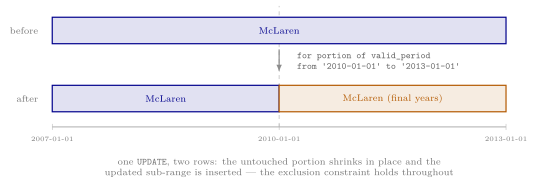 One contract row valid 2007–2013, before and after an UPDATE ... FOR PORTION OF covering 2010–2013. The original row shrinks to the untouched 2007–2010 portion and a second row is inserted for the updated sub-range, so the two never overlap.
One UPDATE produced two rows: the original row shrank to the untouched
portion, and a new row was inserted for the updated sub-range — the
exclusion constraint stayed satisfied throughout. FOR PORTION OF also
applies to DELETE, removing just the requested slice of the range and
leaving the rest of the row(s) intact.
What went wrong
Start again from a single row, and use two sessions, both at the default isolation level:
create table demo_contract
 (
  driverid     bigint not null,
  team         text not null,
  valid_period daterange not null,
  exclude      using gist(driverid with =, valid_period with &&)
);

insert into demo_contract(driverid, team, valid_period)
     values (1, 'McLaren', daterange('2007-01-01', '2013-01-01'));
Session 1 rewrites the first three years of the contract and has not committed yet:
-- session 1
begin;

update demo_contract for portion of valid_period
  from '2007-01-01' to '2010-01-01'
   set team = 'Ferrari'
 where driverid = 1;
Session 2 wants to change a stretch of the same contract that session 1 is not touching. It finds the row, sees that session 1 is modifying it, and waits:
-- session 2
update demo_contract for portion of valid_period
  from '2011-01-01' to '2012-01-01'
   set team = 'Williams'
 where driverid = 1;
Session 1 commits, and session 2 wakes up. It re-checks the row it was waiting on, which now covers 2007–2010 only and no longer matches, and it cannot see the leftover row session 1 inserted for 2010–2013, because that row did not exist when its statement began. There is nothing left for it to update:
UPDATE 0
No error and no warning, and no Williams:
 driverid |  team   |      valid_period
----------+---------+-------------------------
        1 | Ferrari | [2007-01-01,2010-01-01)
        1 | McLaren | [2010-01-01,2013-01-01)
Session 2 was told it changed nothing, which was true. The change it meant to make is simply not in the table. The documentation the feature shipped with described exactly this, with a diagram, along with the workaround: take a lock on the range first, so that the statement doing the work starts only after session 1 is finished. From the same single row, with session 1 doing the same thing:
-- session 2, again
begin;

select *
  from demo_contract
 where driverid = 1
   and valid_period && daterange('2011-01-01', '2012-01-01')
   for update;

update demo_contract for portion of valid_period
  from '2011-01-01' to '2012-01-01'
   set team = 'Williams'
 where driverid = 1;

commit;
 driverid |   team   |      valid_period
----------+----------+-------------------------
        1 | Ferrari  | [2007-01-01,2010-01-01)
        1 | McLaren  | [2010-01-01,2011-01-01)
        1 | Williams | [2011-01-01,2012-01-01)
        1 | McLaren  | [2012-01-01,2013-01-01)
Same two sessions, and both changes survive. The workaround is sound, and it is also the problem: a feature whose correct use at the default isolation level depends on remembering a separate locking query first. Andres Freund suggested raising a serialization failure instead, so that clients retry; Peter Eisentraut’s answer was that he did not find it “a convincing feature with that limitation”, and that the week before the last beta was not the time to explore alternatives.
Shipping it with a footnote would have been easier. The authors had already written the anomaly into the documentation and built a 597-line isolation test suite around the feature, which is the kind of care that makes withdrawing it while there is still time to think an ordinary thing for a release process to do, not a failure of one.
INSERT … ON CONFLICT DO SELECT … RETURNING
ON CONFLICT DO NOTHING and DO UPDATE have existed since PG 9.5, but
neither one gives you back the existing row when a conflict happens — you
had to follow up with a separate SELECT. PG 19 adds a third branch,
DO SELECT, that returns the conflicting row directly, optionally locked
with FOR UPDATE, FOR NO KEY UPDATE, FOR SHARE or FOR KEY SHARE, and
optionally filtered with its own WHERE.
The spelling takes a moment to get used to, because DO SELECT has no
select list:
DO SELECT [ FOR { UPDATE | NO KEY UPDATE | SHARE | KEY SHARE } ] [ WHERE condition ]
SELECT here is an action name, exactly parallel to NOTHING in DO NOTHING — not a query. There is nothing to project, because the conflicting
row is already pinned down by the conflict target; DO UPDATE needs its
SET because you have to say what changes, and DO SELECT needs nothing
because you don’t. The projection goes in the slot INSERT already has,
which is why DO SELECT is the one conflict action for which RETURNING is
mandatory: leave it off and the statement would have nothing to give back,
which would rather defeat the point.
create table demo_driver_seen
 (
  driverid      bigint primary key,
  surname       text not null,
  first_seen_at timestamptz not null default now()
);

insert into demo_driver_seen(driverid, surname)
     values (1, 'Hamilton')
on conflict (driverid) do select
  returning driverid, surname, first_seen_at;
 driverid | surname  |         first_seen_at
----------+----------+-------------------------------
        1 | Hamilton | 2026-09-01 14:44:45.661884+00
Running the exact same statement again, a second later, hits the conflict and returns the existing row instead of erroring or inserting a duplicate:
insert into demo_driver_seen(driverid, surname)
     values (1, 'Hamilton')
on conflict (driverid) do select
  returning driverid, surname, first_seen_at;
 driverid | surname  |         first_seen_at
----------+----------+-------------------------------
        1 | Hamilton | 2026-09-01 14:44:45.661884+00
Same first_seen_at both times — no new row, no round trip to fetch the
conflicting row separately. This is the missing piece for idempotent
“upsert-and-fetch” patterns: registration flows, dedup-on-write ingestion,
anywhere you need the row back regardless of whether this call created it.
Window functions: IGNORE NULLS
lead(), lag(), first_value(), last_value(), and nth_value() now
accept IGNORE NULLS (or the explicit default, RESPECT NULLS), placed
right after the function call and before OVER. Without it, a NULL in
the window simply propagates; with it, the function skips NULLs and finds
the nearest actual value.
Kimi Räikkönen’s 2017 season is a clean example: a DNF at the Spanish Grand
Prix leaves a NULL finishing position for that round.
  select races.round,
         races.name,
         results.position as finish,
         lag(results.position) over(order by races.round) as prev_plain,
         lag(results.position) ignore nulls over(
                                                 order by races.round
                                            ) as prev_ignore_nulls
    from f1db.results
    join f1db.races using(raceid)
    join f1db.drivers using(driverid)
   where drivers.surname = 'Räikkönen'
     and extract(year from races.date) = 2017
order by races.round
   limit 8;
 round |         name          | finish | prev_plain | prev_ignore_nulls
-------+-----------------------+--------+------------+-------------------
     1 | Australian Grand Prix |      4 |            |
     2 | Chinese Grand Prix    |      5 |          4 |                 4
     3 | Bahrain Grand Prix    |      4 |          5 |                 5
     4 | Russian Grand Prix    |      3 |          4 |                 4
     5 | Spanish Grand Prix    |        |          3 |                 3
     6 | Monaco Grand Prix     |      2 |            |                 3
     7 | Canadian Grand Prix   |      7 |          2 |                 2
     8 | Azerbaijan Grand Prix |     14 |          7 |                 7
At round 6, prev_plain shows NULL — the DNF at round 5 propagated
straight through. prev_ignore_nulls shows 3, Räikkönen’s actual last
finish from round 4, correctly skipping over the gap. Before PG 19, getting
this “last known value” behavior required a window frame trick or a
subquery threading a separate counter — a common enough need that it’s now
built in.
CHECK constraints can be un-enforced
PostgreSQL 18 added NOT ENFORCED as a way to declare a constraint —
CHECK or foreign key — that the server records but never checks. PG 19
fills in the missing half: ALTER TABLE ... ALTER CONSTRAINT ... [NOT] ENFORCED now works for CHECK constraints, so you can flip enforcement on
an existing one. Previously only foreign keys could be altered that way.
create table demo_driver
 (
  driverid bigint primary key,
  points   numeric check (points >= 0)
);

insert into demo_driver values (1, 10);

alter table demo_driver
  alter constraint demo_driver_points_check not enforced;

-- would normally violate the check, but enforcement is off
insert into demo_driver values (2, -5);

select * from demo_driver order by driverid;
 driverid | points
----------+--------
        1 |     10
        2 |     -5
Turning enforcement back on validates existing data — and correctly refuses if any row now violates the constraint:
alter table demo_driver alter constraint demo_driver_points_check enforced;
ERROR: check constraint "demo_driver_points_check" of relation "demo_driver" is violated by some row
Worth being precise about what this is and isn’t. If what you want is “add
the constraint now, validate the existing rows later”, that’s ADD CONSTRAINT ... NOT VALID followed by VALIDATE CONSTRAINT, and it has
worked for CHECK constraints since PostgreSQL 9.2 — a NOT VALID
constraint still enforces itself against every new row. NOT ENFORCED is
the stronger, and rarer, thing: the constraint is documented in the catalog
and checked against nothing at all, new rows included. Reach for it when you
want the schema to record an invariant that some other layer is responsible
for enforcing; reach for NOT VALID when you just have a backlog to clean
up.
REPACK replaces VACUUM FULL and CLUSTER
VACUUM FULL and CLUSTER have always done nearly the same thing —
rewrite a table to reclaim space or apply a physical ordering — under two
confusingly different names, with two different lock behaviors. PG 19
unifies them into a single REPACK command (the old names still work, kept
for compatibility), and adds a CONCURRENTLY option that avoids the
access-exclusive lock both predecessors required.
create table demo_bloat
 (
  id  int primary key,
  val text
);

insert into demo_bloat
     select g, repeat('x', 100)
       from generate_series(1, 1000) g;

delete from demo_bloat where id % 2 = 0;

select pg_size_pretty(pg_total_relation_size('demo_bloat')) as before_repack;
 before_repack
---------------
 224 kB
repack demo_bloat;

select pg_size_pretty(pg_total_relation_size('demo_bloat')) as after_repack;
 after_repack
--------------
 112 kB
Same space reclamation you’d get from VACUUM FULL, under one clearer
command name. REPACK CONCURRENTLY table_name is the version that avoids
holding the lock for the whole rewrite — but read its restrictions before
reaching for it. It isn’t MVCC-safe; it’s rejected for unlogged,
partitioned, catalog and TOAST tables, and for any table without a primary
key or replica-identity index; it needs a free slot from the new
max_repack_replication_slots; and it still takes a brief ACCESS EXCLUSIVE at the end to swap the files in.
MERGE PARTITIONS: held back for another release
This section was going to be about ALTER TABLE ... MERGE PARTITIONS and
... SPLIT PARTITION, which restructure a partitioned table in a single
statement instead of the detach/recreate/reattach dance. I wrote it, ran the
queries against Beta 3, and drew a diagram for it.
Then, on August 27, Alexander Korotkov reverted the whole feature from the PostgreSQL 19 branch. I am leaving the section in, because how that decision got made is more interesting than the feature would have been:
The feature is reverted due to multiple design issues which are too late to address in this release cycle.
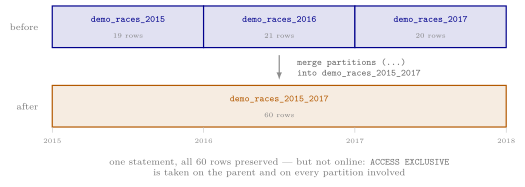 What MERGE PARTITIONS did in Beta 3: three yearly range partitions of demo_races holding 19, 21 and 20 races, folded into a single partition covering 2015-2018 with all 60 rows. The command was reverted from PostgreSQL 19 on August 27, 2026.
That commit takes out 1,631 lines of tablecmds.c, 1,054 lines of
partbounds.c, both isolation test suites, the documentation, and the
PARTITIONS keyword. It is the second time this feature has been held back
late in a cycle — it was pulled from PostgreSQL 17 in August 2024 too, that
time over CVE-2014-0062 repeatable-name-lookup issues.
Reverting two years of work a month before a release is not a failure of the process. It is the process. Somebody found real problems, the people who would have to live with them agreed they were real, and the feature went back in the oven rather than into your database. That decision is available to a project where the engineers have the final say on what ships. It is much harder to make when a release date has been promised to a market.
There is a trap here worth knowing about. At the time of writing the release notes still list the feature, because the entry is still in the release-note source on the release branch — that file was edited on September 1, five days after the revert, and the entry survived. So if you check the official notes and conclude that PG 19 merges partitions, you are reading something the binary will not do. Beta 3, released August 13, still has the feature; anything built after August 27 does not.
What went wrong
The thread that killed it was opened by Zsolt Parragi of Percona on July 23, listing five design problems. Since Beta 3 still ships the feature, I went back and reproduced them. Four of the five fall out in a handful of statements.
A CHECK constraint quietly evaporates. Attributes that belong to the
individual partitions — indexes, constraints, defaults, storage options,
comments — are simply dropped rather than carried across or refused:
create table demo_chk
 (
  id  int not null,
  val text
) partition by range (id);

create table demo_chk_lo partition of demo_chk for values from (0) to (10);

create table demo_chk_hi partition of demo_chk for values from (10) to (20);

alter table demo_chk_lo
  add constraint val_not_forbidden check (val <> 'forbidden');

insert into demo_chk values (1, 'ok');

insert into demo_chk values (2, 'forbidden');
ERROR:  new row for relation "demo_chk_lo" violates check constraint "val_not_forbidden"
DETAIL:  Failing row contains (2, forbidden).
Good — that is the constraint doing its job. Now merge, and run the very same statement again:
alter table demo_chk
  merge partitions (demo_chk_lo, demo_chk_hi) into demo_chk_all;

insert into demo_chk values (2, 'forbidden');

  select id, val
    from demo_chk
order by id;
 id |    val
----+-----------
  1 | ok
  2 | forbidden
No error, no warning, and the row your schema was explicitly rejecting a moment ago is now sitting in the table. The index and the column default went the same way.
Stored generated columns are silently recomputed. A partition can be attached with a generation expression that differs from its parent’s, which is fine until two such partitions are merged and one expression wins:
create table demo_gen
 (
  id int not null,
  g  int generated always as (id * 100) stored
) partition by range (id);

create table demo_gen_lo partition of demo_gen for values from (0) to (10);

create table demo_gen_hi
 (
  id int not null,
  g  int generated always as (id * 2) stored
);

alter table demo_gen
  attach partition demo_gen_hi for values from (10) to (20);

insert into demo_gen values (3), (13);

  select tableoid::regclass as partition, id, g
    from demo_gen
order by id;
  partition  | id |  g
-------------+----+-----
 demo_gen_lo |  3 | 300
 demo_gen_hi | 13 |  26
alter table demo_gen
  merge partitions (demo_gen_lo, demo_gen_hi) into demo_gen_all;

  select tableoid::regclass as partition, id, g
    from demo_gen
order by id;
  partition   | id |  g
--------------+----+------
 demo_gen_all |  3 |  300
 demo_gen_all | 13 | 1300
Row 13 stored 26 before the merge and stores 1300 after it. Nothing in
the statement asked for that, and nothing reported it.
Logical replication sees inserts that never happened. The rows are moved
with plain heap inserts, so a decoding slot reports them as fresh INSERTs
into the new partition — with no matching DELETEs from the old ones:
create table demo_rep
 (
  id  int not null,
  val text
) partition by range (id);

create table demo_rep_lo partition of demo_rep for values from (0) to (10);

create table demo_rep_hi partition of demo_rep for values from (10) to (20);

insert into demo_rep values (1, 'one'), (11, 'eleven');

select slot_name
  from pg_create_logical_replication_slot('demo_slot', 'test_decoding');

alter table demo_rep
  merge partitions (demo_rep_lo, demo_rep_hi) into demo_rep_all;

select data from pg_logical_slot_get_changes('demo_slot', null, null);
                                 data
----------------------------------------------------------------------
 BEGIN 1280
 table public.demo_rep_all: INSERT: id[integer]:1 val[text]:'one'
 table public.demo_rep_all: INSERT: id[integer]:11 val[text]:'eleven'
 COMMIT 1280
A subscriber replaying that stream keeps the rows it already had in the old partitions and adds the new copies on top.
A publication can quietly empty itself. If a publication named one of the
merged partitions directly, it loses it and gains nothing; REPLICA IDENTITY FULL set on a partition reverts to the default too. The publication is still
there, still enabled, and now replicating nothing.
The fifth issue in the thread — losing UPDATEs on a subscriber when
REFRESH PUBLICATION runs with copy_data = false — needs two instances to
show, and I did not try it.
What this costs you, and what it buys
Today, nothing changes: keep detaching, recreating and reattaching partitions the way you already do. That path works, and it has the advantage that every step is one you can see.
Look at what the five problems have in common, though, and the delay starts
to look like good news. Not one of them is about moving rows between files —
that part evidently works, and I ran it. They are all about what a partition
carries: its constraints, its generated columns, its publication membership,
its replica identity. Those are the questions that decide whether the command
is safe to run on a database you care about, and they are exactly the
questions worth taking another release to answer properly. A version of this
feature that moved rows correctly and lost your CHECK constraints would have
been worse than not having it, because you would have trusted it.
So SPLIT/MERGE PARTITIONS will land when the semantics are settled, and
when it does it will be the version that keeps what your partitions carry. On
the evidence above, that is worth waiting for.
One practical note while it is in flight: every other feature in this article is in the release branch and staying there, but this one ran perfectly in Beta 3 and is gone. For anything you intend to depend on before GA, check the branch you will actually run rather than the notes alone.
(For where partitioning stands without it, see the partitioning section of the PG 11–18 round-up.)
Dumping DDL from the catalog directly, withdrawn from 19
Update, 21 September 2026. These three functions were reverted from the 19 branch on 12 September by Andrew Dunstan, after a thread Noah Misch opened on 27 August titled “pg_get_*_ddl() needs a redesign”. They are still in the development branch for 20. Everything below ran on Beta 3, and what went wrong is reproduced at the end of this section.
Three new functions return the CREATE/ALTER statements needed to
recreate an object, straight from the catalog — no external tool required:
pg_get_role_ddl(), pg_get_tablespace_ddl(), and pg_get_database_ddl().
alter role taop set search_path to 'f1db', 'chinook', 'public', 'scan34';

select pg_get_role_ddl('taop'::regrole);
                                   pg_get_role_ddl
-------------------------------------------------------------------------------------
 CREATE ROLE taop SUPERUSER INHERIT CREATEROLE CREATEDB LOGIN REPLICATION BYPASSRLS;
 ALTER ROLE taop SET search_path TO 'f1db', 'chinook', 'public', 'scan34';
select pg_get_database_ddl('taop'::regdatabase);
                                              pg_get_database_ddl
----------------------------------------------------------------------------------------------------------------
 CREATE DATABASE taop WITH TEMPLATE = template0 ENCODING = 'UTF8' LOCALE_PROVIDER = libc LOCALE = 'en_US.utf8';
 ALTER DATABASE taop OWNER TO taop;
Each function returns a setof text, one row per statement, in the order
they need to run — the role’s own CREATE ROLE first, then any ALTER ROLE ... SET session defaults. Each also takes optional flags beyond the object
itself: pretty on all three, plus memberships for roles and
owner/tablespace for databases. What comes back is a decompiled
reconstruction, not the text you originally typed. Previously this meant reaching for pg_dumpall --roles-only or a third-party script; now it’s a plain SQL query, scriptable
from inside any migration tool that already talks to the database.
What went wrong
Misch’s objections were several; two of them can be seen in one small experiment. A role with a password, a search path and a per-database setting:
create role demo_app login password 'correct horse battery staple';

alter role demo_app set search_path = f1db;

alter role demo_app in database taop set work_mem = '64MB';

select pg_get_role_ddl('demo_app'::regrole);
                                          pg_get_role_ddl
---------------------------------------------------------------------------------------------------
 CREATE ROLE demo_app NOSUPERUSER INHERIT NOCREATEROLE NOCREATEDB LOGIN NOREPLICATION NOBYPASSRLS;
 ALTER ROLE demo_app SET search_path TO 'f1db';
 ALTER ROLE demo_app IN DATABASE taop SET work_mem TO '64MB';
The password is missing. The function leaves it out, on the grounds that exposing one through a SQL function would be a security problem. The tool it was meant to replace does not:
$ pg_dumpall --roles-only | grep -A1 '^CREATE ROLE demo_app'
CREATE ROLE demo_app;
ALTER ROLE demo_app WITH NOSUPERUSER INHERIT NOCREATEROLE NOCREATEDB LOGIN NOREPLICATION NOBYPASSRLS PASSWORD 'SCRAM-SHA-256$4096:…';
That is the stored hash, shortened here, never the plaintext, and it is what makes a restored role one somebody can log in as. Misch’s point was that a function which cannot produce it is not a way to migrate roles.
The order is wrong for a restore. The last line of the output above,
IN DATABASE taop SET, cannot run until database taop exists, and the
databases may be owned by the roles. Restoring into an empty cluster means
roles first, then databases, then those settings, and pg_dumpall does exactly
that: CREATE ROLE on line 16 of its output, CREATE DATABASE taop on line
139, and ALTER ROLE demo_app IN DATABASE taop on line 164. One function
returning one role’s statements in one payload leaves the caller to do that
dependency analysis, which was the work it was supposed to take away.
The third objection I cannot demonstrate, only report: the patch added a second
implementation, 361 lines in ddlutils.c, of translating catalog state into SQL
next to the one pg_dump already has, and Misch’s position was that the tree
should carry one. Together they say something useful about the problem itself.
pg_dumpall is an ordering and dependency algorithm at least as much as a text
generator, and any function that returns its statements has to make the same
decisions. That is not a small feature, and it is a better reason to keep it out
of a release than a bug would have been.
Ranges: subtracting with gaps
Subtracting a range out of the middle of another has been possible since
multiranges arrived in PG 14 — datemultirange(a) - datemultirange(b)
returns a multirange with a gap in it. What PG 19 adds is the convenient
form: range_minus_multi() and multirange_minus_multi() take plain
ranges and hand you back a setof anyrange, one row per surviving
fragment, with no multirange wrapping and unwrapping in between.
select range_minus_multi(
         daterange('2007-01-01', '2013-01-01'),
         daterange('2010-01-01', '2011-01-01')
       );
    range_minus_multi
--------------------------
 [2007-01-01,2010-01-01)
 [2011-01-01,2013-01-01)
Plain range subtraction (-) has always required the subtracted range to
sit at one end — subtracting from the middle raises an error, because the
result isn’t representable as a single range. range_minus_multi() sidesteps
that by returning a set instead. (multirange_minus_multi() always returns
a single row, since one multirange can already hold any result.)
Two small functions that pull their weight
Not everything in a release needs a section of its own, but these two are short enough to show and useful often enough to remember.
random() over dates and timestamps
random() has returned a double precision between 0 and 1 since forever,
and PG 17 added integer and numeric ranges. PG 19 completes the set with
date, timestamp and timestamptz versions, which is exactly what you
want when generating test data over a period:
select setseed(0.42);

select random('2017-03-26'::date, '2017-11-26'::date) as race_day,
       random(
         timestamp '2017-03-26 12:00', timestamp '2017-03-26 16:00'
       ) as lights_out
  from generate_series(1, 5);
  race_day  |         lights_out
------------+----------------------------
 2017-10-02 | 2017-03-26 13:43:47.198578
 2017-11-20 | 2017-03-26 12:18:25.009763
 2017-04-19 | 2017-03-26 13:01:14.162498
 2017-07-29 | 2017-03-26 13:51:27.212232
 2017-08-20 | 2017-03-26 15:35:52.873462
Bounds are inclusive, and the setseed() call is there so that run
repeats — drop it and you get fresh values each time. Before this you wrote
the arithmetic yourself, something like '2017-03-26'::date + (random() * 245)::int, which works but has to be re-derived every time and quietly gets
the endpoints wrong about half the time anybody writes it.
error_on_null()
error_on_null(x) returns x, or raises if x is NULL. That sounds
almost too small to bother with until you think about where NULL comes
from in a query you did not expect it in — a scalar subquery that matched
nothing:
select (select driverid from f1db.drivers where surname = 'Raikkonen');
 driverid
----------
No error. One row, one NULL, because the surname is spelled Räikkönen
and a scalar subquery that matches nothing is a perfectly legal NULL. That
value then flows into whatever comes next — a join that quietly returns no
rows, an IN list that never matches, an arithmetic expression that turns
the whole column NULL. It is one of the great silent bugs in SQL, and the
usual advice is to notice it in review.
Now you can just say what you meant:
select error_on_null(
  (select driverid from f1db.drivers where surname = 'Raikkonen')) as driverid;
ERROR: null value not allowed
Spell it correctly and it returns the value and gets out of the way:
select error_on_null(
  (select driverid from f1db.drivers where surname = 'Räikkönen')) as driverid;
 driverid
----------
        8
It is polymorphic — anyelement in, the same type out — so it drops into an
expression anywhere without a cast, and it costs you a comparison. Think of
it as an assertion you can write inline, in the place where the assumption
actually lives, rather than in a comment above the query.
SQL/PGQ: withdrawn from 19, four days after this went out
Update, 7 September 2026. This section described a feature that is no longer in PostgreSQL 19. On the evening of the 7th, Peter Eisentraut — SQL/PGQ’s own author — reverted the whole thing from the release branch, 47 commits of it. I published this on the 3rd. Everything below ran on Beta 3 and is what the feature did; none of it is what PostgreSQL 19 will ship.
I am leaving it, for the same reason the MERGE PARTITIONS section above
is still here, and because two independent withdrawals from one release
cycle say something the working feature would not have.
The call came from Melanie Plageman writing for the Release Management
Team, in the thread on catalog representation and pg_dump
support,
over four unresolved problems. DROP TABLE ... CASCADE left orphaned
label and property metadata behind — phantom rows in information_schema
that could make later alterations fail and, worse, “render the graph
undumpable/unrestorable”. Labels and properties were scoped globally
rather than per-label, so a view over a GRAPH_TABLE could become
“silently unqueryable” after a property was dropped from one element while
still existing on another, a case the standard does not settle. There were
open questions about whether property graphs should have pg_class entries
at all. And there was an unresolved pg_dump dependency loop when a
materialized view queries a GRAPH_TABLE.
The RMT’s argument was about time, not merit: reverting “would take off the time pressure now and would make it easier to fix these things properly in 20 without having to be burdened by backwards compatibility and backpatching.” Note what that has in common with the partitions story — both features were pulled over what an object carries and how it is dumped, not over whether the headline feature worked. It worked. I ran it.
One practical note, and it is the same trap as before: at the time of
writing the docs site still serves
ddl-property-graphs.html
because it has not rebuilt yet. The release notes, to the project’s credit,
were corrected in the revert commit itself this time.
The rest of this section is preserved as written.
PostgreSQL 19 implemented SQL/PGQ,
Part 16 of the SQL standard, which let you query relational tables using
graph pattern syntax. It is worth being clear about what that does and does
not mean. A property graph is not a new storage engine and not a copy of
your data: CREATE PROPERTY GRAPH behaves like CREATE VIEW, recording a
logical structure that is resolved at query time against the same tables you
already have. Permissions come from the base relations, not from the graph.
You declare which tables are vertices, which are edges, and how the edges
connect. The Lab’s geoname schema has exactly this shape already: country
keyed by isocode, and neighbour holding pairs of bordering countries with
a foreign key at each end.
create property graph borders
  vertex tables (
    geoname.country key (isocode) label country properties (name, iso)
  )
  edge tables (
    geoname.neighbour key (isocode, neighbour)
      source key (isocode) references country(isocode)
      destination key (neighbour) references country(isocode)
      label borders
  );
Now the graph can be pattern-matched with GRAPH_TABLE, which takes a
MATCH pattern and a COLUMNS projection and returns an ordinary relation:
  select neighbour
    from graph_table (borders
               match (c is country where c.name = 'France')
                     -[is borders]->(n is country)
             columns (n.name as neighbour))
order by neighbour;
  neighbour
-------------
 Andorra
 Belgium
 Germany
 Italy
 Luxembourg
 Monaco
 Spain
 Switzerland
(c is country) is a vertex with a label, -[is borders]-> is a directed
edge, and columns decides what comes back. That query is a join written in
a different shape, and the documentation says so itself — it gives the
equivalent SELECT ... JOIN right beside its own example. Which is rather
the point: the graph is a way of asking, over data that stays exactly where
it was, with the permissions it already had.
What lands in a later release
The next thing you will want is a longer question. Not “who borders France” but “how far does France reach”. In the SQL/PGQ standard you say that with a quantifier on the edge pattern — one to four hops:
  select distinct reachable
    from graph_table (borders
               match (c is country where c.name = 'France')
                     -[is borders]->{1,4}(n is country)
             columns (n.name as reachable))
order by reachable;
ERROR: element pattern quantifier is not supported
Not yet, then. Variable-length paths are the next patch, and with them the
things that surround them: nested path patterns, several path patterns in one
GRAPH_TABLE, subqueries inside it, aggregates and window functions in
COLUMNS, ANY SHORTEST and ALL SHORTEST.
Notice what the error message is, though. It is not a syntax error — the parser understood the quantifier perfectly and told you precisely which part of the standard has not been wired up yet. The grammar is in place, and it knows the shape of what is coming.
You can spell a fixed number of hops out by hand, and that does work:
  select distinct two_hops
    from graph_table (borders
               match (a is country where a.name = 'France')
                     -[is borders]->(b is country)
                     -[is borders]->(c is country)
             columns (c.name as two_hops))
order by two_hops
   limit 8;
 two_hops
-----------
 Andorra
 Austria
 Belgium
 Czechia
 Denmark
 France
 Germany
 Gibraltar
That is one pattern per depth, and it returns France itself, because nothing
stops the walk revisiting a vertex — TRAIL and ACYCLIC, the standard’s way
of saying “don’t do that”, arrive with the quantifiers. So for reachability,
shortest paths and transitive closure, keep reaching for WITH RECURSIVE,
which has answered those questions since PostgreSQL 8.4 and is not going
anywhere. It is what I used on this very dataset in the PG 11–18
round-up:
that map of everywhere you can drive from France in four hops is a recursive
CTE, and a good one.
Why it was still the right amount to ship
It would be easy to read “no variable-length paths” as PGQ arriving half-finished. I would read it the other way round — and the revert does not change that reading, it sharpens it.
What landed is the part that is tedious, invasive and hard to change later: five new system catalogs, a parser that understands the full pattern grammar, name and label resolution, permission checks that defer to the base tables, and a rewriter that turns a matched pattern into an ordinary plan. None of that is glamorous, and all of it is load-bearing. Variable-length paths are a genuinely hard planning problem — you are asking the optimizer to cost a recursive walk — and they are much better attempted on top of a settled foundation than alongside one.
That ordering is a choice, and it is the same one visible in the MERGE PARTITIONS story earlier: get the semantics right, ship the part you are sure
of, leave the hard part for when it can be done properly. It is what a release
process looks like when the engineers decide what is ready, rather than a
calendar or a feature-comparison table. Oracle 23ai shipped SQL/PGQ first, and
PostgreSQL is not racing it.
What the revert adds is that the same standard gets applied to the
foundation, not only to the parts left out of it. The query layer worked —
that is the part I demonstrated, and it is the part a release under
commercial pressure would have shipped. What was not finished was catalog
housekeeping: what happens to a label when a CASCADE sweeps past it,
whether pg_dump can put the thing back. Nobody writes a launch blog post
about pg_dump round-tripping. It is exactly the sort of unglamorous
correctness that gets deferred when a date is promised, and exactly what
you are relying on the day you restore a backup.
Two features pulled from one release for that reason is not a project struggling to ship. It is a project that would rather be a year late than be wrong in your database, twice in the same cycle, from people who had every incentive to let their own work through. The rest builds on this, one release at a time. That is how PostgreSQL has always gotten where it is going, and it is why the pieces still fit together twenty years on.
Worth watching, not yet covered here
This article stops at the SQL layer, and PostgreSQL 19 is a large release. Here is what I left out, with a note on why each one is worth its own treatment rather than a paragraph.
Planner stability
pg_plan_adviceandpg_stash_advice— two new extensions for stabilizing planner decisions: the first lets you record and replay a known-good plan shape, the second applies stored advice automatically based on the incoming query. Aimed squarely at the “the plan changed after a statistics update and now everything is slow” problem. This is the release’s most consequential feature for anyone running a large OLTP system, and it deserves a proper workout rather than a summary — plan hinting has been the single longest-running argument in this community, and what shipped is a more interesting answer than either camp was asking for.
Replication
- Logical replication now replicates sequence values. If you have ever
cut over to a logical replica and discovered every
nextval()handing back a number the publisher used months ago, this is the release that fixes it.CREATE PUBLICATION ... FOR ALL SEQUENCES,ALTER SUBSCRIPTION ... REFRESH PUBLICATION SEQUENCES, and a newpg_get_sequence_data()to see what the subscriber thinks it has. - Logical replication no longer needs a restart. With
wal_level = replica, PG 19 raises the effective level automatically when a slot first needs it, and reports what is actually in force through the new read-onlyeffective_wal_level. The prerequisite that made “just add logical replication” a maintenance-window conversation is gone. WAIT FOR— blocks until a standby has replayed WAL to a given point, giving read-your-writes against a replica without pollingpg_stat_replication. Small in surface area, but it changes what you can safely route to a standby, which is an architecture question.- Also in this area:
retain_dead_tupleson a subscription, for conflict detection (with amax_retention_durationcap, and a newupdate_deletedcount inpg_stat_subscription_stats), publications that can exclude tables, and subscriptions that can borrowpostgres_fdwconnection parameters instead of repeating a connection string.
Operations
- Online data checksums were withdrawn on 16 September. The plan was
that
pg_enable_data_checksums()andpg_disable_data_checksums()would let you turn checksums on and off while the server runs, where today it meanspg_checksumsagainst a stopped cluster, which is why most clusters that started without checksums stayed without them. The feature collected a number of post-commit fixes during the beta, and rather than ship it with the risk of more surfacing after GA, Daniel Gustafsson reverted it from the 19 branch; a few independent fixes stayed. It is still in the development branch for 20. - Parallel autovacuum and a priority scoring system for which
tables get vacuumed first. The parallel part is opt-in —
autovacuum_max_parallel_workersdefaults to 0 — and only covers the index phases. The scoring half is the more interesting one: five weighting variables and apg_stat_autovacuum_scoresview, which turns “why has this table not been vacuumed” into a question with an answer. - Automatic scaling of I/O workers, following through on PG 18’s
asynchronous I/O. If you tuned
io_method = workerlast year, revisit it:io_min_workersandio_max_workersnow let the pool size itself. - New observability surface:
pg_stat_lockfor per-lock-type statistics,pg_stat_recovery,pg_get_multixact_stats(), and WAL full-page-image byte accounting inVACUUM/ANALYZElogging. Also worth knowing before your log volume changes:log_lock_waitsis now on by default, autovacuum’s analyze logging moved to its ownlog_autoanalyze_min_duration, and wraparound warnings now start at 100 million transactions instead of 40 million. - Server-side SNI, so one instance can present different certificates by requested hostname.
Smaller SQL additions, for completeness
oid8, a 64-bit unsigned integer type.encode()/decode()gainbase64urlandbase32hex.- Casts between
byteaanduuid, and morejsonpathstring methods. GRANT/REVOKE ... GRANTED BY, to name the role doing the granting.- Full-text stemmers for Polish and Esperanto.
Working these examples up for the new edition of The Art of PostgreSQL is what sent me through the PG 19 notes in this much detail. What is left maps straight onto existing chapters on constraints, upserts and window functions. The two features that would have landed in the temporal-ranges and partitioning chapters were both withdrawn, which suits me fine: I would rather write those chapters against the version that ships.